
Storm Drain Systems for Housing Layouts: What Builders Must Plan Before Monsoon
Every year when the monsoon hits Andhra Pradesh and Telangana, many new housing layouts end up flooded. Streets go underwater, plots get waterlogged, and homebuyers start making angry calls.
The reason is almost always the same: no proper planning for storm drain systems.
If you’re a builder or developer, this is not something you fix after handing over the property. It has to be built into the layout design from the very beginning.
Why Stormwater Drainage Planning Cannot Wait
Most builders during the layout planning stage focus on plot sizes, road widths, and RERA compliance. Stormwater drainage usually gets pushed to the bottom of the list, something to deal with later.
That’s where things go wrong.
Cities like Hyderabad, Vijayawada, and Guntur get anywhere between 600mm to 1000mm of rainfall every year. Most of it falls within just 3 to 4 months. Without a proper storm water drainage system, even a few hours of heavy rain can flood internal roads and damage foundations.
Fixing drainage after construction is expensive. Planning it before construction is not.
How a Storm Water Drainage System Works in a Housing Layout
A storm water drainage system collects rainwater runoff from roads, open areas, and rooftops and moves it safely out of the layout into a municipal drain or natural water body.
For a housing layout, the system usually includes:
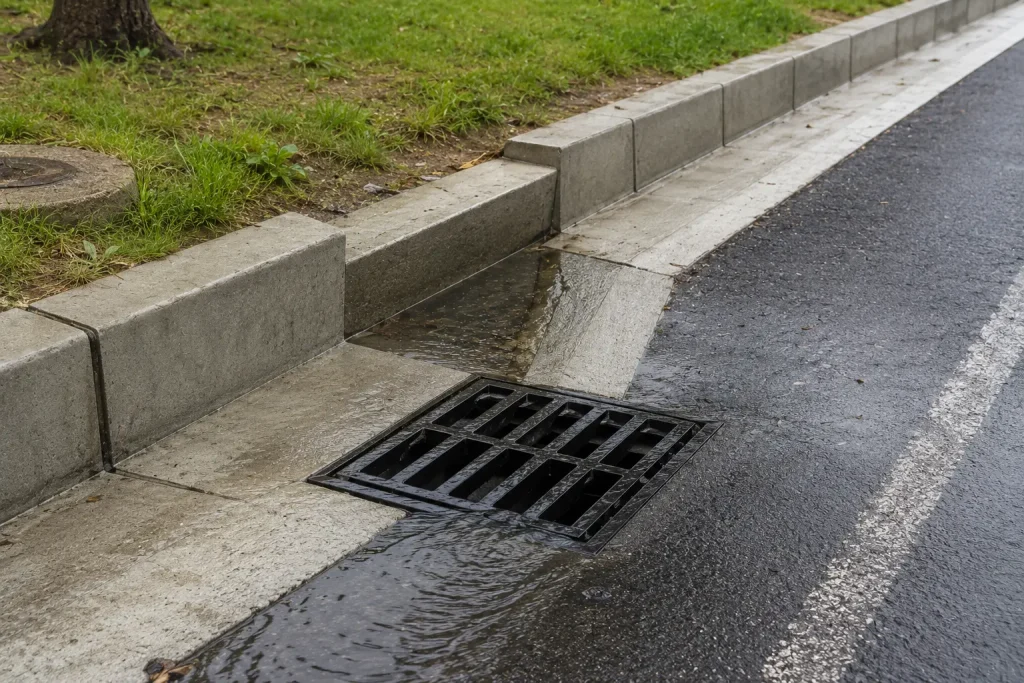
Surface drains running along internal roads to collect water from plots and pavements. Catch basins and inlet grates placed at low points and road crossings to capture concentrated runoff. Underground pipes or open channels that carry the water to a discharge point. Outlet connections linked to the nearest municipal drain or approved water body.
In flat areas like much of coastal Andhra this needs careful grading and slope design because water won’t flow unless you create the right gradient.
The Real Problem with a Clogged Storm Water Drain
One of the most common failures in residential layouts is not thinking about maintenance. A clogged storm water drain is not just a small problem; it causes road damage, stagnant water, mosquito breeding, and the kind of flooding that makes plots difficult to sell.
In layouts on the outskirts of Hyderabad and in growing towns like Kakinada, Nellore, and Kurnool, builders often install drainage lines but forget to plan for cleanout access. Within a season or two, silt, debris, and construction waste block everything.
Simple fix: Include inspection chambers every 15 to 20 metres and at every direction change. This makes future cleaning practical and affordable.
Want to Know More About Designing a Better Layout?
Read our detailed eBook on layout development covering drainage design, road planning, and RERA-ready approvals in one place.
What HMDA and CRDA Say About Rain Water Drainage Systems
Both HMDA in Telangana and CRDA in Andhra Pradesh require a proper rain water drainage system as part of layout approval. Builders need to account for this early.
Here’s what the norms generally require:
Drain widths must be calculated based on the catchment area and local rainfall intensity. Layouts above a certain size need a drainage design report from a licensed engineer. Connecting to existing municipal drainage networks requires prior approval from the local body. Open drains in pedestrian areas must be covered.
Builders who skip this end up facing approval delays, expensive redesigns, or disputes with buyers after possession.
Picking the Right Storm Water Drainage Solutions for Your Layout
Every layout is different. The right storm water drainage solutions depend on your terrain, layout size, soil type, and local rainfall patterns.
For flat layouts in coastal Andhra: (Vizag, Rajahmundry, Eluru): Use gravity-fed systems with carefully designed slopes or pump-assisted drainage. Underground RCC pipe networks work well here.
For sloped or elevated terrain: (parts of Telangana, Nalgonda, Khammam): Open surface channels with energy dissipators handle faster runoff more effectively.
For large township projects: A combination of retention ponds, bioswales, and underground drain networks gives the most reliable system and may also help meet green building requirements.
Picking the wrong system doesn’t just create flooding. It creates legal liability.
Final Thoughts
The monsoon in Andhra Pradesh and Telangana is not a surprise. It comes every single year. What is avoidable is the damage it causes when storm drain systems are not properly designed.
As a builder, your drainage plan is more than just an engineering checkbox. It’s a commitment to every family that buys a plot trusting that their home won’t flood every August.
Plan it right. Plan it before you break ground.
Want to get your layout’s drainage design reviewed before HMDA or CRDA submission? Speak with a drainage consultant who understands local norms in Telangana and Andhra Pradesh.
Frequently Asked questions (FAQ's)
A storm drain system in a housing layout is a network of surface drains, catch basins, underground pipes, and outlet connections designed to collect and direct rainwater runoff away from roads, plots, and structures to prevent flooding and waterlogging.
Storm water drains get clogged due to silt buildup, construction debris, plastic waste, and lack of regular maintenance. Layouts without inspection chambers make it difficult to clean the drains, which worsens the blockage over time.
Yes. HMDA (Hyderabad Metropolitan Development Authority) requires builders to include a stormwater drainage plan as part of the layout approval process. Layouts above a certain size must submit a drainage design report from a licensed engineer.
Storm drain systems are typically constructed using RCC pipes, HDPE pipes, concrete box culverts, reinforced concrete channels, and precast drainage components.
